Emozi Logo

Emozi® Implementation Toolkit For Character Champions/Administrators

Section 1: Pre-Launch Checklist

Launching Emozi® with success begins with thoughtful planning and strong foundational structures. The following checklist ensures your team is prepared for a smooth and impactful rollout.

1. Establish a Leadership Team to Oversee Implementation

Purpose: A dedicated team is essential to guide implementation, ensure alignment with school goals, and maintain accountability.

Action Steps:

Tip: Include at least one champion from each grade band being implemented to build peer support across the school.

2. Use the Vision-Building Templates to Align Stakeholders

Purpose: A shared vision for character development ensures buy-in from staff, families, and students.

Action Steps:

Optional: Present this vision during your staff kickoff or back-to-school night to highlight schoolwide priorities.

Emozi® Vision Building

3. Identify Grade Levels or Pilot Classrooms for First Rollout

Purpose: Starting small allows your team to build confidence, refine routines, and gather success stories to inspire broader buy-in.

Action Steps:

4. Set Baseline Data on Student Behavior, Climate, or Engagement

Purpose: Baseline data provides a snapshot of the current school climate and student needs, which is critical for measuring growth and success.

Action Steps:

5. Plan a Pre-Launch Staff Orientation

Purpose: Ensures teachers understand the goals of Emozi®, how to access materials, and where to go for support.

Action Steps:

Section 2: Rollout Planning Guide

A thoughtful rollout strategy helps ensure the Emozi® program becomes a visible, consistent, and valued part of your school culture. Whether launching schoolwide or in phases, this guide helps you make key decisions to support success.

1. Choose Phased vs. Full Implementation by Grade Bands

Purpose: Determining the scale of your initial rollout helps you plan training, coaching, and support effectively.

Options:

Considerations:

Tip: If starting with a pilot group, schedule a midpoint review to assess readiness for scale-up.

2. Align Emozi® Content with School Calendars or Themes

Purpose: Integrating Emozi® with schoolwide initiatives, literacy themes, or character education calendars increases relevance and visibility.

Action Steps:

Resource: Use the Emozi® Year-at-a-Glance planning template (available upon request) to create your scope and sequence.

3. Schedule Family Communication Rollouts Alongside Program Launch

Purpose: Engaging families early helps build trust and reinforces key concepts at home.

Action Steps:

4. Plan for Visibility: Bulletin Boards, Announcements, Home Letters

Purpose: Creating visual and verbal reminders around the school builds enthusiasm and normalizes program language.

Ideas: Suggested Materials:

Note: Consistent visibility reinforces the message that character development is a schoolwide priority.
Section 3: Training & Professional Development Menu

Ongoing professional development is essential for building staff confidence, ensuring consistent implementation, and deepening the impact of Emozi®. This section outlines options for preparing and supporting staff throughout the school year.

1. Introductory Emozi® Training (Virtual)

Purpose: Provide staff with a shared understanding of Emozi®'s goals, structure, and classroom application.

Training Focus:

  • Overview of the Emozi® program and age-band materials (Mini Emozi®, Elementary, Middle, High School)
  • How character development supports academic and behavioral outcomes
  • Lesson components and pacing recommendations
  • Tips for leading discussions, modeling strategies, and adapting for diverse learners

Format Options:

  • 120-minute virtual session
  • Optional follow-up Q&A or coaching sessions
  • Use the provided slide deck and facilitator notes to guide internal training if led by school/district staff

Tip: Combine training with planning time for teachers to review materials by grade level and plan initial lessons.

New Staff Onboarding Checklist

2. New Staff Onboarding Guide

Purpose: To ensure new hires, substitutes, or staff joining mid-year are quickly brought up to speed with Emozi®, so implementation remains consistent across classrooms.

Quick Orientation Checklist (30-60 minutes)
    Welcome & Purpose: Short overview of why Emozi® matters for your school.

    • Share your school's vision for character development.
    • Emphasize Emozi® as a schoolwide priority that builds student success academically, socially, and behaviorally.
    • Reinforce that every teacher contributes to the common language and culture of Emozi®.

    Program Overview: Emozi® structure, weekly lessons, and strategies used at the grade band.

      Walk through the Emozi® structure:
    • Weekly lessons (15-25 minutes depending on grade band).
    • Character development strategies integrated into daily routines.
    • Visibility through posters, announcements, and home connection letters.
    • Highlight grade-band differences: Mini Emozi® (PreK-2), Elementary (3-5), Middle (6-8), and High School (9-12).

    Access:

    • Show how to locate lesson materials and pacing guide for their grade level.
    • Provide pacing guide for their grade level so they can align with where the class is currently.
    • Point to quick resources: unit overviews, troubleshooting guide, coaching toolkit.

    Key Strategies:

    • Mini Emozi®: Ollie's Wise Choices (Halt, Hoot, Heart)
    • Elementary: STAR (Stop, Think, Act, Reflect) or daily reflections prompts.
    • Middle School: SCOPE (Stop, Consider, Options, Plan, Evaluate)
    • High School: SCOPE-IT (Stop, Consider, Options, Plan, Evaluate, Insights, Transform)
    • Encourage new staff to use posters and cue words in routines right away, even before teaching a full lesson.

    Support Contacts: Who to go to for questions (coach, Emozi® Champion, administrator).

    • Identify the Emozi® Champion/Coach at the school who can provide modeling, materials, or lesson planning help.
    • Provide administrator point of contact for implementation questions.
    • Share peer “buddy” teacher assignments for informal support

    ✨ Tip for Administrators: A short, supportive orientation within the first two weeks helps new staff feel confident and ensures students don't miss consistent exposure to Emozi® language and lessons.
Suggested First Steps
  • Teach or observe a current Emozi® lesson within the first week.
  • Post Emozi® posters and vocabulary in the classroom.
  • Use at least one quick routine (e.g., STAR or daily reflection) right away.
  • Review pacing guide to see where students are in the curriculum.
Onboarding Resources (provide links/attachments)
Administrator Action Steps
  • Schedule a short onboarding session with every new hire within 2 weeks of start.
  • Pair new staff with a grade-level Emozi® “buddy” or champion teacher.
  • Monitor implementation through a walkthrough in the first month.
  • Celebrate their first Emozi® lesson with a shoutout in staff communications.
Tip: Keep onboarding simple and focused on getting started right away, then layer in more depth over time.

3. Suggested 15-Minute Staff Meeting Discussion Starters

Purpose: Embed bite-sized Emozi® learning into existing staff meetings to maintain momentum and foster peer sharing.

How to Use:
  • Select one topic or question per meeting (examples below)
  • Provide a discussion prompt and invite quick reflection or breakout conversations
  • Reinforce learning with a printed takeaway or classroom strategy
Sample Topics
  • “What surprised you during your first few Emozi® lessons?”
  • “How are students responding to the character language?”
  • “What's working well for classroom management during discussions?”
  • “What barriers have you experienced—and how have you handled them?”
Note: These short reflections create space for problem-solving and peer encouragement without requiring additional meeting time.

4. Peer-Led PD Structures Using the Emozi® Coaching Toolkit

Purpose: Empower teacher leaders to support implementation and encourage a culture of shared practice.

Options:
  • Grade-Level PD Circles: Teachers in similar grade bands meet monthly to share lesson pacing, student responses, and activity adaptations.
  • Walk-and-Share Sessions: Teachers observe short segments of lessons in other classrooms, followed by a debrief session.
  • Implementation Spotlights: One teacher shares a success story or challenge and invites group discussion.
Resources: Tip: Create a rotating “Teacher Feature” where peer leaders share a strategy or student success during staff meetings.
Section 4: Fidelity & Reflection Tools
Consistent, high-quality implementation is key to achieving positive student outcomes with Emozi®. This section provides tools for self-monitoring, coaching, and reflecting on growth over time, both for educators and the program as a whole.

1. Teacher Self-Assessment Checklist

Purpose: Support educators in reflecting on their own practice and identifying areas of strength and growth.

How to Use:
  • Share at start, midpoint, and end of year.
  • Reflect on lesson delivery, student engagement, and classroom integration.

Sample Indicators:
  • I prepare in advance and follow the lesson structure.
  • I use open-ended questions to guide student discussion.
  • I model character strategies and reference them throughout the day.
  • I provide time for student reflection and encourage skill use beyond the lesson.
Tip: Use responses to inform individual coaching, peer mentoring, or staff development planning.

Teacher Self-Assessment Checklist

2. Admin/Coach Observation Template

Purpose: Provide structured feedback to teachers while gathering schoolwide implementation data.

How to use:
  • Conduct brief walkthroughs or scheduled observations (10-20 minutes)
  • Emozi® Admin Walkthrough Tool

  • Focus on lesson pacing, student participation, use of Emozi® language, and classroom climate
  • Offer strengths-based feedback and 1-2 suggestions for growth

Observation Snapshot May Include:

  • Are Lesson Goals visible or posted?
  • Is the teacher using Emozi® vocabulary and modeling strategies?
  • Are Students engaged and participating respectfully?
  • Are strategies being reinforced beyond the lesson (e.g., during transitions or conflicts)?

Optional: Use a digital form to streamline data collection and reporting.

Coaching Support Materials

3. Implementation Milestone Timeline

Purpose: Track progress across the year and support schoolwide accountability.

Suggested Milestones:
  • Leadership team established and trained ✅
  • Vision and rollout plan finalized ✅
  • Staff training completed ✅
  • First unit taught in all selected classrooms ✅
  • Mid-year review and feedback session held ✅
  • End-of-year reflection and next-step planning ✅
Action Steps:

  • Set milestone dates in advance and assign responsibility to team members.
  • Celebrate milestones visibly (e.g., staff shout-outs, bulletin board updates, emails from leadership).
Tool: Include this timeline in staff handbooks or implementation binders to support shared responsibility.

4. Post-Unit Reflection Questions (Educators & Students)

Purpose:Promote meaningful reflection and continuous improvement after each unit.

For Educators:
  • What strategies did students respond to most?
  • Which parts were engaging or challenging?
  • How did I adapt lessons?
  • What improvements will I make next unit?
For Students (Sample prompts):
  • What was your favorite activity?
  • What new skill did you learn?
  • How did you use that skill outside the lesson?
  • What would you tell a new student?
Tip: Use student responses for hallway displays, family newsletters, or end-of-year portfolios.

5. Tiered Support & Intervention Guidance

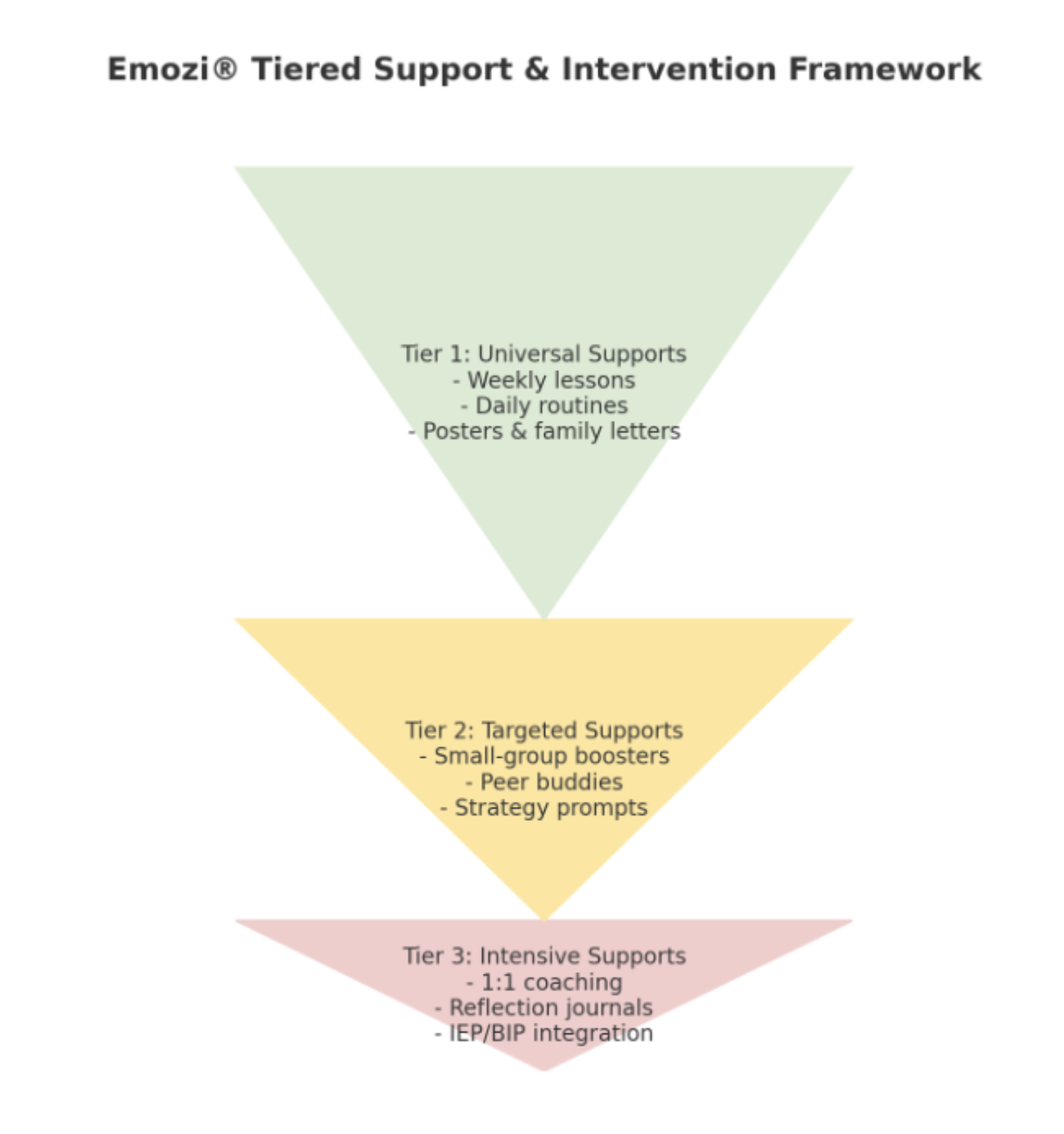
Purpose: Emozi® is a Tier 1 universal program, designed for all students. However, some students may need additional practice, support, or intervention to fully benefit. This section outlines how administrators and staff can align Emozi® with a Multi-Tiered System of Support (MTSS) or Response to Intervention (RTI) framework.

Tier 1: Universal Supports (All students)
  • Weekly Emozi® lessons taught with fidelity.
  • Daily reinforcement through class routines (e.g., STAR during transitions).
  • Visible Emozi® posters, bulletin boards, and morning announcements.
  • Family engagement through newsletters and home connection letters.
Goal: Every student receives consistent exposure and practice with Emozi® skills.

Tier 2: Targeted Supports (Small Groups)

  • Identify students who need extra practice through teacher observation, discipline data, or self-assessments.
  • Provide small-group booster sessions (10-15 minutes weekly) focused on practicing core strategies (e.g., STAR, SCOPE).
  • Pair students with peer buddies for accountability.
  • Encourage staff to prompt strategy use during high-stress moments (e.g., test prep, transitions).
Example: A small group of 4th graders practices role-playing STAR every morning before class begins.

Tier 3: Intensive Supports (Individualized)

  • Collaborate with counselors, special educators, or behavior teams.
  • Provide 1:1 coaching on strategies tied to individual goals (e.g., managing anger, staying focused).
  • Use Emozi® reflection journals for daily check-ins.
  • Integrate Emozi® strategies into individualized education plans (IEPs) or behavior intervention plans (BIPs).
Example: A middle school student with frequent outbursts practices SCOPE steps daily with a counselor, then applies them in class with teacher prompts.

Administrator Action Steps:

  • Use walkthrough data and teacher feedback to identify students who may benefit from Tier 2 or 3 supports.
  • Ensure Emozi® Champions or coaches are trained to provide small-group boosters.
  • Partner with counselors to embed Emozi® strategies into existing behavior plans.
  • Monitor impact through data: referrals, attendance, self-assessments, and teacher reports.
Tip: Emozi® is most effective when seen as a shared foundation for all students—with clear pathways for those who need more support. Emozi Tiered approach
Section 5: Data & Impact Tools

1. Data Dashboard Template

Suggested Categories to Track:
  • Assessments

    • Pre-test completion rate (%)
    • Post-test completion rate (%)
    • Growth trends (average % increase)

  • Staff PD Participation

    • % of teachers trained
    • PD sessions completed (#)
    • Coaching or check-ins completed (#)

  • Fidelity Measures

    • % of classrooms observed using Emozi® strategies
    • Evidence of Emozi language in hallways, lunchroom, recess (from Walkthrough Tool)
    • Teacher self-assessment completion rate (%)

  • Family Engagement

    • Parent attendance at Emozi® Nights (#)
    • Newsletter messages sent (#)
    • Family feedback (survey % positive)

2. Annual Review Guide

A structured reflection process for administrators.
    Step 1: Review Data

  • What do assessment results show?
  • How many staff participated in Emozi® PD?
  • How consistently was Emozi implemented (lesson delivery + daily routines)?
  • How engaged were families?
    Step 2: Celebrate Successes

  • Student growth stories (academic, behavior, social-emotional).
  • Teacher feedback highlights.
  • Family/community involvement successes.
  • Recognition moments (assemblies, student leaders, media coverage).
    Step 3: Identify Challenges

  • Were there barriers to fidelity (time, materials, staff turnover)?
  • What gaps appeared in training or coaching?
  • Where was family engagement harder to build?
    Step 4: Set Goals for Next Year

  • Implementation goal (e.g., 90% fidelity across classrooms).
  • PD goal (e.g., all new hires complete Emozi® training within 30 days).
  • Family/community goal (e.g., host 2 Emozi® parent/student events).
  • Data goal (e.g., 95% completion of pre/post assessments).
    Step 5: Plan Sustainability Moves

  • Assign 2 staff champions (teacher + admin).
  • Update succession planning checklist.
  • Strengthen peer networking.
  • Add Emozi® to school improvement plan.

3. Success Story Collection Template

Prompts to capture stories, testimonials, and photos for communication.

    Who:

    • Student name/grade (first name only if sharing publicly)
    • Teacher/staff role
    • Parent/family member


    What to Capture:

    • Describe the Emozi® strategy used (HALT-HOOT-HEART, STAR, SCOPE, SCOPE-IT).
    • What challenge did it help solve?
    • How did the student/staff/family feel afterward?
    • What was the outcome (improved focus, resolved conflict, better choices)?


    Prompts:

    • “Tell us about a time Emozi helped in your classroom/home.”
    • “What's one way you've seen a student grow through Emozir?”
    • “What's a proud moment you've experienced using Emozi®?”
    • “How has Emozi changed your classroom, school, or family conversations?”

    How to Use:

    • Keep a shared folder for quick story uploads.
    • Collect monthly at staff meetings or through short surveys.

    • Use in:
      • Board presentations
      • Newsletters/social media posts
      • Grant or funding reports
      • Celebration events


Section 6: Communication Templates

1. Emozi® Introductory Letter for Families

Clear, proactive communication builds trust and enthusiasm for Emozi® among families, staff, and the wider school community. Use the following templates to introduce the program, keep stakeholders informed, and reinforce key messages across platforms.

Purpose: Introduce Emozi®'s goals, structure, and benefits in family-friendly language.

When to Use: Before program launch or during the first few weeks of implementation.

Template Excerpt:

    Dear Families,

    We're excited to share that our school is launching a new character development program called Emozi®! This program supports students in building important life skills, like managing emotions, solving problems, making respectful choices, and working well with others.

    Each week, your child will engage in a short lesson and discussion that encourages personal growth and strong classroom relationships. You'll also receive occasional “Home Connection” letters with ways to continue the conversation at home.

    We believe that helping students grow as kind, thoughtful individuals benefits not only their academic success but our entire school community.

    Thank you for your partnership!

    Sincerely,

2. Slide Deck Outline for Parent Night

Purpose: Present Emozi® in a clear, engaging format during family engagement events.

Suggested Slide Topics:

  • Welcome & Introduction
  • Why Character Development Matters
  • What is Emozi®? (Overview of program and grade-level themes)
  • What Will My Child Be Learning?
  • How Can Families Support at Home?
  • Q&A / Contact Information

3. Principal Memo for Staff Kickoff

Purpose: Set the tone for implementation and emphasize leadership support.

When to use: Prior to staff training or the first week of Emozi® lessons.

Template Excerpt:

    Dear Team,

    As we begin this school year, I'm thrilled to announce that we'll be rolling out the Emozi® Character dDvelopment program across our school. This is part of our commitment to supporting the whole child academically, socially, and emotionally.

    Emozi® gives us a common language and a consistent structure to help students build self-awareness, empathy, and strong decision-making skills. I encourage you to lean into this program, ask questions, and share what's working.

    Together, we can make a lasting impact on how students learn and grow—not just in school, but in life.

    With appreciation,

    [Principal Name]

4. Social Media Post Examples to Build Visibility

Emozi® Media and PR toolkit

Purpose: Keep Emozi® present in your school community's digital spaces.
  • Sample Post 1 - Launch Announcement:

    🎉 We're launching Emozi®—our new character development program that helps students build confidence, empathy, and resilience. Stay tuned for lessons, home tips, and classroom highlights! #WeAreEmozi® #CharacterMatters #Emozi®Launch

  • Sample Post 2 - In-Class Highlight:

    This week, our 2nd graders explored how to be a good friend during Emozi® time. We talked about listening, taking turns, and showing kindness—even when it's hard. ❤️ #Emozi®InAction #BuildingCharacter

  • Sample Post 3 - Family Engagement:

    Families—check your child's folder for our Emozi® Home Connection letter! This week's focus: handling big feelings with calming strategies. 🌱 #Emozi®AtHome #SchoolFamilyConnection
Tip: Include a photo (e.g., student work, bulletin board, Emozi® characters) and use consistent hashtags.

5. Family Engagement Planning Guide

Family Engagement Planning Guide

To help administrators and leadership teams plan intentional, consistent family engagement throughout the year. When families are included beyond the launch, they reinforce Emozi® strategies at home and help sustain schoolwide enthusiasm.

Section 7: Professional Growth and Sustainability Tools
Section 8: Troubleshooting Waning Implementation

Purpose: To help administrators recognize and address natural dips in implementation energy, whether in the mid-year “February slump” or during later years when enthusiasm begins to wane. By anticipating these dips, leaders can re-energize staff, reinforce fidelity, and sustain Emozi® as a meaningful part of school culture.

1. Recognizing Signs of Waning Implementation

Watch for these indicators that implementation energy is slowing:

  • Lessons skipped or condensed more frequently
  • Student engagement dropping during lessons or limited use of Emozi® strategies outside the classroom
  • Staff expressing time pressures, fatigue, or competing priorities
  • Decreased visibility of Emozi® (posters taken down, fewer announcements, reduced family communication)

2. Diagnosing Root Causes

Administrators can use a quick diagnostic lens:

  • Structural challenges: Schedule conflicts, testing season, staff turnover
  • Cultural challenges: Perception of Emozi® as repetitive or less relevant
  • Leadership challenges: Reduced visibility or messaging from administrators
  • Capacity challenges: New staff not fully trained, limited coaching or peer support
Tip: Use the Admin Walkthrough Tool and Teacher Self-Assessment (Sections 4 & 7) to pinpoint specific needs.

3. Mid-Year Re-Energizers (February Slump)

Simple actions can reinvigorate staff and students:

  • Revisit the Vision Statement: Share your school's Emozi® vision in staff meetings or newsletter.
  • Mini-Refresh PD: 20 minutes of staff meeting spotlighting one strategy or success story.
  • Quick Wins: Use grade-level strategies from the Emozi® Troubleshooting Guide.
  • Celebrate Success: Highlight student growth with shoutouts, assemblies, or newsletters.

4. Multi-Year Sustainability Boosters

When enthusiasm dips after the first year or two, consider:

  • Rotate Leadership Roles: Bring in new Emozi® champions to re-energize the team.
  • Student Voice: Invite students to co-lead lessons, share testimonials, or create Emozi® displays.
  • Visibility Refresh: Update bulletin boards, posters, morning announcements.
  • Schoolwide Integration: Embed Emozi® into school improvement plan, discipline policies, or advisory curriculum.

5. Administrator Action Steps

Practical steps leaders can take immediately:

  • Conduct a fidelity pulse check using walkthroughs and staff surveys.
  • Pair struggling teachers with peer mentors or Emozi® champions.
  • Use staff meetings for 1-2 minute Emozi® shares to keep strategies fresh.
  • Communicate consistently: keep Emozi® present in staff memos, parent newsletters, and social media.

6. Resources & Tools

  • Emozi® Troubleshooting Guide → Quick reference by grade band
  • Coaching Toolkit & PD Starters → Peer-to-peer learning supports (see above section 4.2)
  • Implementation Milestone Timeline → Helps track and celebrate progress (see above section 4.3)
  • Success Story Collection Template → Capture and share wins to maintain momentum (see above section 5.3)

Closing Note: Implementation naturally ebbs and flows. By anticipating dips and responding with visibility, recognition, and targeted supports, administrators ensure Emozi® continues to thrive, becoming a sustainable, celebrated part of school culture.

Section 9: Appendix